Fiber optic connector is one of the critical parts for the fiber optic cable and it comes in different configuration & types. In common, fiber cable connectors can be classified in several dimensions such as the using environment, number of fibers, mode of fiber type, transmission pattern (mode), transmission media, boot length, surface type and gist type of termination et al. This article has worked out a classification for fiber connector types according to these different paradigms.
Application: Fiber Connectors Interfacing with Adapter Panels
Common optical connector types including LC, SC, MTP, MPO and ST all rely on adapter panels for stable interconnection. These fiber connectors are widely deployed in data centers, telecommunications rooms, enterprise networks and other high-density wiring environments.
1. LC Connector
An LC (Lucent Connector), is an SFF (Small Form Factor) connector it has a 1.25 mm ferrule. This design, with its small footprint, has gained these fiber optic connectors tremendous popularity in datacoms and even more suitability for high-density applications. Today, most people have shifted to high-efficiency cabling with the LC fiber connectors. Today, the LC fiber optic connector is recognized as the most widely used connector.
2. SC Connector
The first connector chosen for the TIA-568 standard was SC and is a snap-in connector with a push-pull that latches. SC refers to "Square Connector" because of its "square-shaped" connector body. Most notably, the LC connector has been replaced with a 2.5mm ferrule–twice that of previous LC size format. SC fiber optic connector is suitable for datacoms and telecom applications including point-to-point and passive optical networking. As it performs excellent, fiber optic SC connector is still the second hand for polarization maintaining applications.
3. MTP/MPO Fiber Connector
Because the MTP/MPO fiber connector is an multi-fiber connector, it has only one common rectangle ferrule which combines 12 to 24 fibers in a single design with larger sizes than other connectors. Otherwise, that is commonly applied to the 40G and 100G optical parallelism connections. The MTP/MPO fiber connector is a complicated connector due to the key-up, key-down, male and female problems.
4. ST Connector
An early development of the FC type, the ST (Straight Tip) fiber optic connector was developed and patented by AT&T. The ST optic connector holds the fiber with a ceramic, spring-loaded 2.5mm ferrule that locks into place with a half-twist bayonet mount. They are primarily used in long and short distance of source applications, such as multimode fiber applications specifically for campus and building frameworks,civilian corporate network surroundings, military operatendous routines.
5. FC Connector
FC stands for Ferrule Connector. The FC fiber optic connector was the first of its kind to utilize a ceramic ferrule. In contrast to the SC and LC connector, which has a body made of plastic, it uses a rounded form with nickel-plated or stainless steel screw-type fitment. The FC fiber optics connector end face is inserted using an alignment key and then secured into the adaptor/ jack by a threaded collet. Despite this added complexity at both manufacturing and installation stages, they also give choice – for example in precision instruments (OTDR) and a solution for single modefiber is offered with the FC connector. Originally designed for datacoms and telecoms applications, it has been superseded to some extent with the introduction of SC and LC fiber optic connectors. ST and FC connector usage has also trended downwards over the past few years.
The abovementioned five fiber optic connectors are the most commonly used ones, which are introduced based on their popularities from wide to usual. The figure below shows the different connector style:
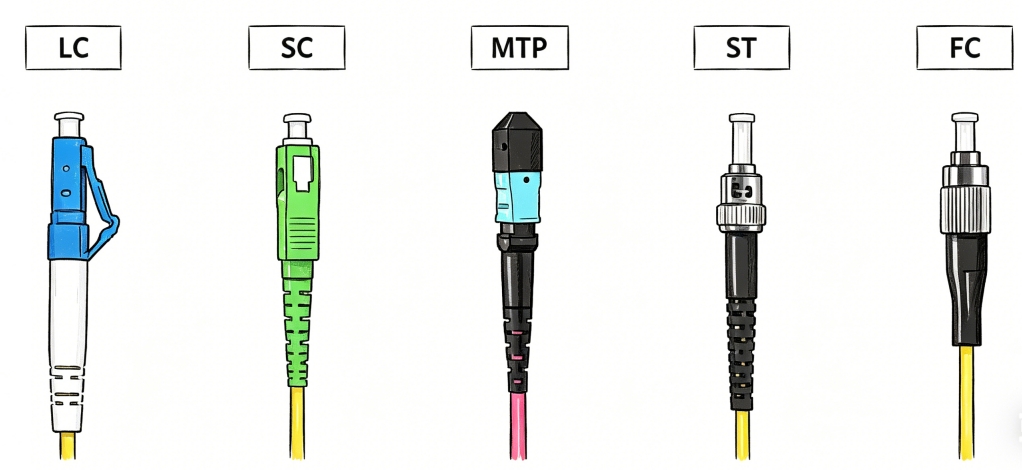
Figure1: 5 types of fiber connector
Simplex vs Duplex: Fiber Connector Configurations
When it is a simplex connector, it means that the signal flow only goes in one direction (a simplex connector through two simplex connectors and a simple cable device A can transmit signals to device B but cannot return from device B to Device A). On the contrary, duplex connectors as well as duplex fiber cabling can be revised with one another and are called a duplex connection. Moreover, simplex fiber optic connector is commonly connected with a single strand of glass or plastic fiber, whereas duplex fiber optic connector must connect with two strands of fibers.
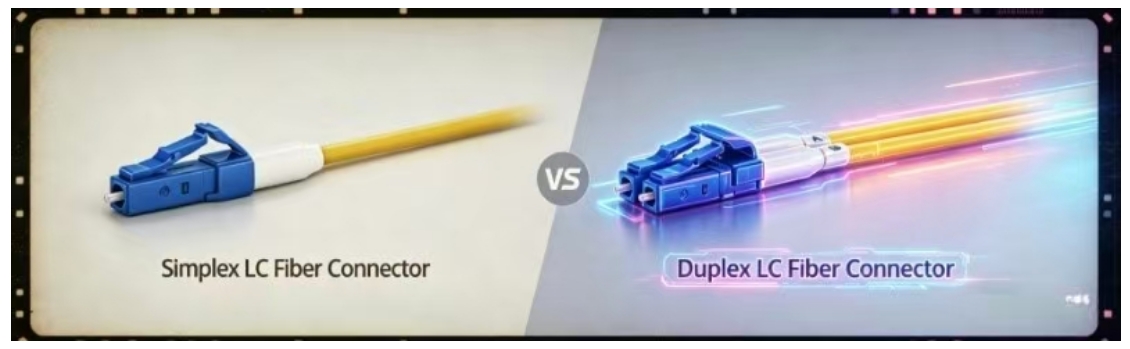
Figure2: Simplex and Duplex Fiber Connector
Single Mode vs Multimode Fiber Connectors
Single mode fiber permits only a single light mode to be used at one time and also, multimode fiber can pass more than 1 modes at once. Diversity actually affects single mode fiber connectors and multimode fiber connectors because of the blend with respective optical fibers. But, with new technologies emerging, SC LC FC fiber optic connectors as found in a Fiber Optic Connector Factory will work on both single mode and multimode fiber cables.
Standard vs Short Boot Fiber Connectors
Boot structure has a standard boot length and short boot list time. A ruggedized boot may prevent cable/connector damage, wires getting yanked out of the connector body, etc. The ultimate goal for a short boot is the same, but it sets itself apart with a briefer heel means. Short boot cables are perfect for instances where space is limited for connector. The short boot structured design may help the cables pass through the narrow space easier with no performance loss, and makes the installation and maintenance of fibers more efficient.
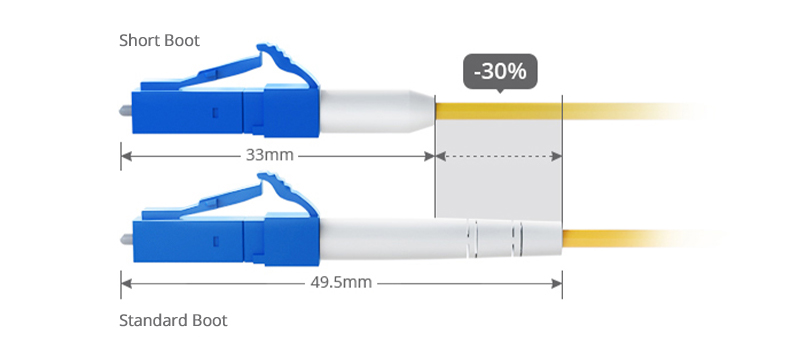
Figure3: Short Boot vs Standard Boot
Connector Endface Polishing: APC vs PC vs UPC
Optical fiber cable connectors can be categorized into three types based on polishing type of connector, ie. PC, UPC and APC connectors A color code is a simple way to figure out these three kinds of connectors, The color code for PC's is black, the color code of fiber connector used by APC is green, and the connection from the UPC is blue. There is still a difference in the structure and performance of each fiber optic connector, which will also be reflected in the values of insertion loss and return loss. So this will help you knowing about PC vs UPC vs APC: What Do These Connector Types Mean?
FAQs
Does single mode connectors fit on multimode cables?
Yes. Single mode connectors will work on multimode — but not vice versa.
What can I do if I want to use LC type but an SC connector has been installed?
One such solution is that you buy from SC-SC coupler, then get an SC to LC pre terminated patch cable. Adapters like LC-LC or LC-SC are also available.
What types of fiber optic connectors that exist on the market?
Generally, the fiber optic connectors can be classified into LC, SC, MTP/MPO, ST and FC. As one of the main types among all fiber optic connectors, LC connector is often regarded as the most common type because it offers compact dimensions with excellent performance and makes terminations easy. The MTP/MPO connectors are also gaining more popularity in 40G and 100G transmissions over multi-fiber connectors.


