Wavelength Division Multiplexing (WDM) is a technique that enables simultaneous transmission of multiple data streams across the optical fiber network. There are two major technologies of Wavelength Division Multiplexing - Coarse Wavelength Division Multiplexing (CWDM) and Dense Wavelength Division Multiplexing (DWDM). Depending on the needs of network and user, a given environment is suited only for one solution from multiple solutions.
Both technologies are agnostic to protocol, meaning any mix of data, storage voice or video can be carried on the separate wavelength channels. With the same in fiber, regarding CWDM and DWDM technologies is basically in their spectral positionisoning that spacing between transmission channels along ticthe electromagnetic spectrum second approach.
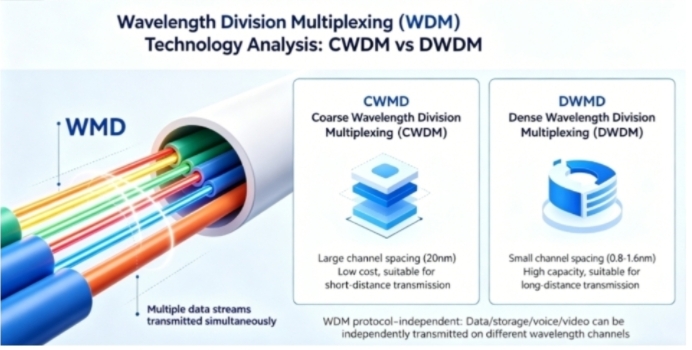
CWDM: Coarse Wavelength Division Multiplexing
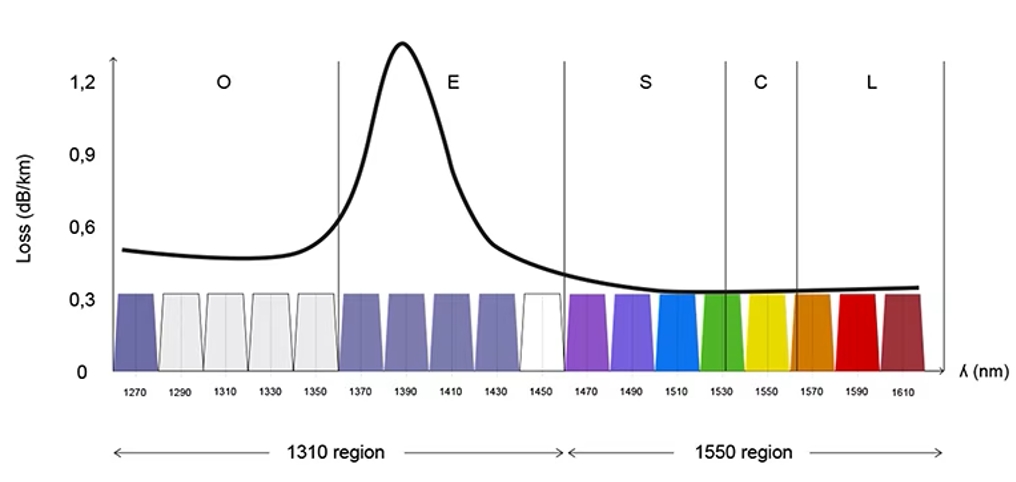
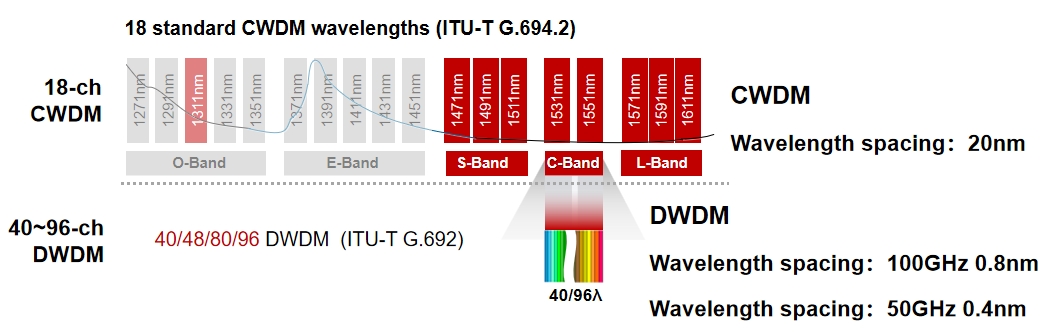
CWDM can multiplex 18 wavelength channels over a dark fiber at the same time. This is realized by keeping the different wavelengths, 20nm apart from each channel. The most popular wavelength regions associated with CWDM are 1310nm and 1550nm. The 1550nm region is preferred due to lower loss in the fiber (i.e. it can carry the signal over long distance).
For such shorter distances, up to 70 kilometers CWDM technology is a more practical and economical solution. However CWDM is often limited on the number of channels to support at distances between 40 and 70 kilometers due to the water peak of the fiber (read more on that below).
DWDM: Dense Wavelength Division Multiplexing
DWDM allows for up to 80 independent wavelength channels, each channel spaced only 0.8nm apart. DWDM connections can be amplified, which allows data to be transmitted over much greater distances than CWDM.
CWDM works best in the 10 Gigabit Ethernet and 16G Fibre Channel realms. And even less probable capacities will grow over this in the future. On the other hand, DWDM operates at higher speed protocols (up to 100Gbps per channel) providing better technology for such high speed protocols.
CWDM components have been much cheaper than DWDM components and hence making CWDM more popular. The cost for both solutions is now about the same. Higher speed, more channel capacity, longer distances and passive networking has made Dense Wavelength Division Multiplexing (DWDM) technology the go-to for green field installations.
CWDM & DWDM: Wavelength Differences and Characteristics
Figure shows the wavelength spectrum with respects to CWDM channels so how DWDM channels 's fitted into it. Every single CWDM channel is 20nm isolated from its neighboring channel. Legend: Color-coded 8 CWDM channels in the 1550 region also shown on the figure. There is no standard coloring scheme for the 1310 regions.
In contrast most of the DWDM channels are concentrated in the 1530 and 1550nm For CWDM. A color scheme has not been standardized for DWDM channels either: probably just as well since recalling the different visible colors might be too much for the naked eye to handle in relation to the many DWDM channels. Rather, therefore we use a block to signify where that they are grouped.
Choosing Between CWDM and DWDM
CWDM connectivity is limited to 70km; DWDM could go 80km that we said too. However, if we also consider the fact that DWDM can be amplified at much longer distances, this is where things become even more relevant. Since all DWDM channels can be found mostly in the rather “flattened-out” 1550nm range of the fiber, they are more suitable for amplification.
CWDM should be in consideration, if you already have a CWDM solution and the system has space on it to grow. Once that capacity is fully consumed If you wish to proceed up the layers, your two options are starting over with a higher band DWDM system at some etc or overlaying across channels 1530 and 1550nm you essentially have another 26 channels on top again using a “hybrid DWDM” on top of those CWDM paths!
The DWDM systems have been traditionally designed and used by the telcos along-for fixed vertically integrated systems, which as a result has brought in its wake large real estate requirements. This is the reason that CWDM was a much more prevalent option for corporate data center interconnectivity for years. However, the enterprise data center landscape today has more flexible solutions available for DWDM as well, thus making it a much more practical option.
CWDM vs DWDM
Wavelength division multiplexing (WDM) technology encompasses two major types of coarse (CWDM) and dense WDM (DWDM). Both employ multiple wavelengths of light on a single fiber, but differ in the spacing of the wavelengths, number of channels and amplification capability of the multiplexed signals.
In contrast to CWDM, DWDM has closely spaced wavelengths and can be used with amplified connections. This means that it is possible to send data over longer distances. CWDM has been known to be a low cost solution for some time now, however in the current market costs are similar between the two. Your choice will depend on what your network and your users need.


